PROJECT NOTES
RC Boat Design
Engineering Project
Design and build of an RC speed boat.

Project Brief
Working in a team of seven, with two project managers supporting the team but not contributing hands-on, we designed and built a remote-controlled speed boat intended to operate in a weed-choked waterway.
The project imposed tight constraints on available materials, components, tools and fabrication time. Construction was limited to scheduled workshop sessions, and the finished boat was required to pass formal scrutineering before racing.
Boat Design
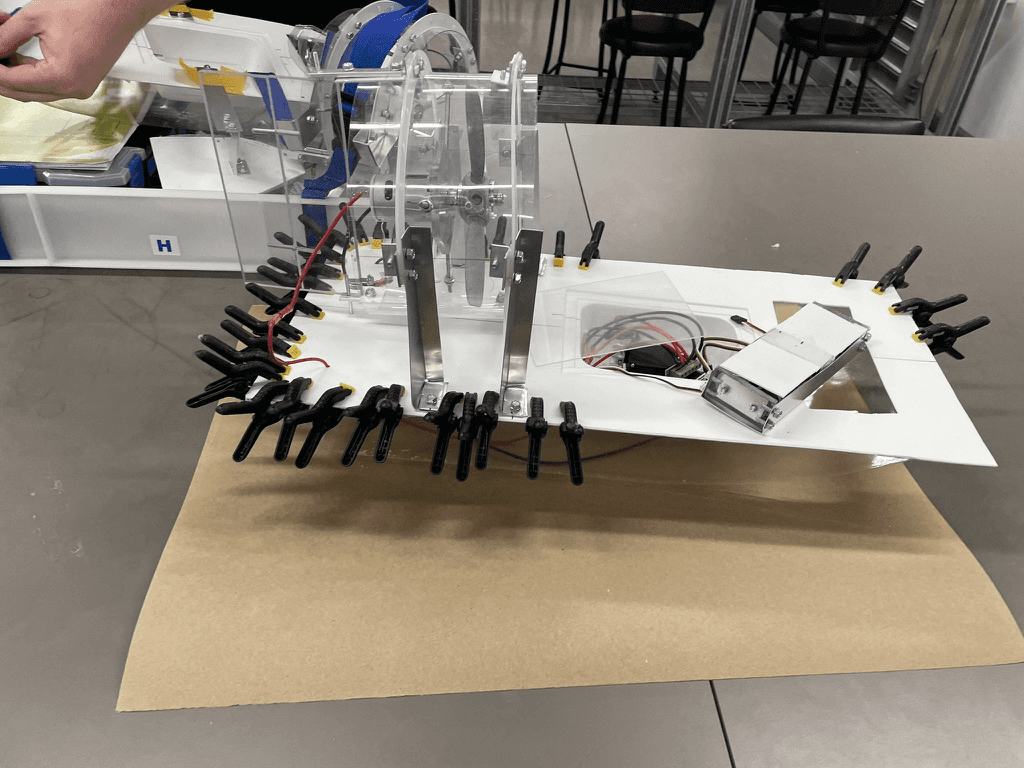
The boat used a vacuum-formed PETG hull with a TPS deck and a centrally positioned watertight compartment for the control electronics. Propulsion came from a shroud-mounted 540 DC motor driving a three-blade air propeller set at 20°, while steering used a servo-operated pushrod connected to a PETG air rudder.
A six-cell C-battery pack supplied a nominal 9 V, with an RC relay providing remote motor reversal and a separate manual on/off switch.
My Contribution
Before fabrication began, the team divided responsibilities between three members working on the wider boat design, two assigned to electronics, and two focused primarily on CAD. I was part of the three-person design group and carried out much of the research used to inform the overall layout and key design decisions.
During the workshop sessions, I initially worked on the main mechanical structure. I vacuum-formed the barge hull and carried out much of the fabrication and fitting of the motor and propeller shroud, including making and attaching the shroud hinges and measuring the supports used to position it. Other team members completed the final attachment of the shroud supports to the boat.
As the build progressed, the electronics work had fallen behind schedule, so I stepped in and took responsibility for much of the electrical layout and integration. I worked with another team member on fabrication, installation and wiring, including the watertight compartment, servo, RC relay, receiver, receiver battery, switch and associated wiring.
A key challenge was fitting these components inside the WTC while maintaining steering clearance, access to removable components and a reliable seal. This required coordinating the electrical layout with the pushrod steering system and the surrounding mechanical structure.
Scrutineering & Repair
I was one of the two team members responsible for the boat during the restricted 30-minute repair period after it initially failed scrutineering. The inspection assessed the boat against requirements including buoyancy and watertightness, steering and effective navigation, remote reverse, battery installation, and the security and operation of the control and propulsion systems.
We reopened sections of the boat and traced several faults, including a steering pushrod that had become dislodged from the rudder and an RC relay connection that had been disconnected when components were removed for storage. I worked on restoring the relay and electrical system while we corrected the steering fault.
The repairs were completed within the allotted period and the boat successfully passed reinspection.
Outcome
The boat successfully passed reinspection after the 30-minute repair period. However, the steering system was later damaged during handling and painting between scrutineering and race day, so the boat did not ultimately race.

TECHNOLOGIES / SKILLS
Hand Tools / Basic Electronics